



Texas Instruments TDEL1G522/-Q1 Single Filtering Delay Elements

Texas Instruments TDEL1G522/-Q1 Single Filtering Delay Elements provide fixed-time signal delays with pulse filtering. The delay can be selected via the S0 and S1 configuration pins without external timing components. Pulses shorter than the selected delay are filtered out, supporting signal deglitching, delaying, and debouncing.
The Texas Instruments TDEL1G522/-Q1 devices include two interchangeable Schmitt-trigger inputs and complementary push-pull outputs. When one input receives the signal, the other selects whether the operation is inverted or non-inverted. The I/O clamp diodes protect against overvoltage and undervoltage transients, while the TDEL1G522-Q1 adds AEC-Q100 qualification for automotive applications.
Features
- Preconfigured digital timing without external timing components
- Filtering of pulses shorter than the selected delay
- Four selectable fixed-time delay settings
- Two interchangeable Schmitt-trigger inputs
- Inverted and non-inverted operating modes
- Complementary push-pull outputs
- I/O clamp diodes for overvoltage and undervoltage transient protection
- Low supply current
- TDEL1G522-Q1
- AEC-Q100 qualified for automotive applications
- Device temperature Grade 1
- HBM ESD classification Level 2
- CDM ESD classification Level C4B
Applications
- Deglitch a signal
- Delay a signal
- Debounce both edges of a signal
Specifications
- One delay channel
- Selectable delay times
- 30µs
- 100µs
- 1ms
- 10ms
- Typical delay variation of 1%
- Maximum delay variation of 10%
- Maximum output drive current
- 12mA low-level output current
- -12mA high-level output current
- Supply voltage range of 1.65V to 5.5V
- Typical supply current of 3µA
- Maximum continuous digital output current of ±20mA
- Maximum pulsed digital output current of ±100mA for 1µs
- Maximum continuous current through VCC or GND of ±60mA
- Operating temperature range of -40°C to +125°C
- 8-pin SOT-5X3 package
- Package dimensions of 2.1mm x 1.6mm
Evaluation Module
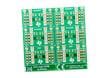
Texas Instruments 5-8-LOGIC-EVM Evaluation Module
Developed to support leaded Logic devices in the DBV, DCK, DCT, DCU, and DRL packages.
Datasheets
Functional Block Diagram
